Many people feel unhappy with their smile because of chipped, stained, or damaged teeth. These problems can affect confidence when talking, smiling, or even taking photos, and many patients are unsure which dental treatment can fix the issue.
Two common solutions often recommended by dentists are crowns and veneers. Understanding the difference between a dental crown and Porcelain Veneers can help you choose the treatment that best suits your needs and improves your smile.
What Is a Dental Crown?
When a tooth becomes weak, damaged, or heavily filled, it may need extra protection to restore its strength. This is where a crown becomes a useful dental solution.
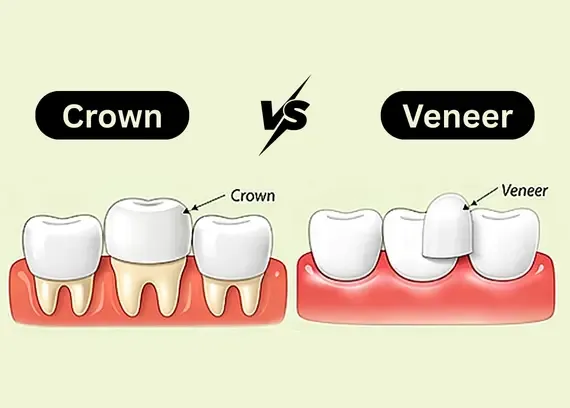
A crown is a custom made cap that completely covers a damaged tooth. It restores the shape, size, and strength of the tooth while improving its appearance. Dentists often recommend a dental crown when a tooth is cracked, severely worn, or weakened after a large filling or root canal treatment.
Crowns are designed to look natural and blend with surrounding teeth. They help protect the remaining tooth structure and allow patients to bite and chew comfortably again.
Pros of Dental Crowns
• Provide strong protection for weak or damaged teeth
• Restore both function and appearance of the tooth
• Durable and suitable for heavy chewing pressure
• Long lasting when maintained with proper oral care
Cons of Dental Crowns
• Require more removal of natural tooth structure
• Usually more expensive than some cosmetic treatments
• May require multiple dental visits
• Not always necessary for purely cosmetic concerns
What Are Veneers?
Some dental concerns are more about appearance rather than tooth damage. In these cases, veneers are often recommended to improve the cosmetic look of a smile.
Porcelain Veneers are thin shells that are placed on the front surface of teeth. They are designed to improve the color, shape, and alignment of teeth, making them look brighter and more even.
Veneers are commonly used to correct problems such as stained teeth, small gaps, uneven teeth, or minor chips. Because they are thin and carefully crafted, they can create a natural looking smile while preserving most of the natural tooth structure.
Pros of Veneers
• Improve the appearance of teeth quickly
• Require minimal removal of natural tooth enamel
• Provide a natural and aesthetically pleasing smile
• Effective for correcting stains, minor chips, and small gaps
Cons of Veneers
• Mainly cosmetic and do not strengthen damaged teeth
• May not be suitable for severely weakened teeth
• Can chip or crack if exposed to excessive force
• Usually not reversible once placed
Dental Crown vs Veneer: Understanding the Key Difference
Many patients get confused when deciding between these two treatments because both can improve the appearance of teeth. However, they serve different purposes depending on the condition of the tooth.
| Feature | Crown | Veneers |
|---|---|---|
| Coverage | Covers the entire tooth | Covers only the front surface of the tooth |
| Purpose | Restores strength and protects damaged teeth | Improves the appearance of teeth |
| Tooth Preparation | Requires more reshaping of the natural tooth | Requires minimal removal of tooth enamel |
| Best For | Severely damaged, cracked, or weak teeth | Discolored, uneven, or slightly chipped teeth |
| Durability | Strong and suitable for chewing pressure | Durable but mainly designed for cosmetic enhancement |
| Appearance | Designed to restore both function and appearance | Designed mainly to enhance smile aesthetics |
This comparison helps patients understand how these treatments work and which option may be more suitable depending on the condition of their teeth and their smile goals.
When Is a Crown the Better Option?
Sometimes a tooth becomes too weak or damaged to function properly. In such cases, restoring the strength of the tooth becomes more important than just improving its appearance.
A crown is often recommended when the tooth structure needs protection and support. This treatment helps restore the shape and strength of the tooth so it can function normally again.
Situations where a crown may be the better option:
• Severely damaged or broken teeth: If a tooth has large cracks or has broken significantly, a crown can cover and protect the remaining tooth structure.
• After root canal treatment: Teeth that have undergone root canal treatment often become weaker. A crown helps protect the treated tooth from further damage.
• Large dental fillings: When a tooth has a very large filling and little natural structure left, a crown provides extra strength and stability.
• Severe tooth decay: In cases where decay has damaged a large portion of the tooth, a crown helps restore both function and appearance.
• Worn down teeth: Teeth that are worn due to grinding or long term wear can be rebuilt and protected using a crown.
• To restore chewing function: Crowns help restore the ability to bite and chew comfortably, especially when the natural tooth has been weakened.
Crowns are designed to protect and strengthen teeth that cannot be restored with simpler treatments. They are often the best option when the main goal is to restore durability and full function.
When Are Veneers a Better Choice?
In many cases, teeth may be healthy but do not look aesthetically pleasing. People often choose veneers when they want to improve the overall appearance of their smile.
Veneers focus mainly on cosmetic enhancement rather than repairing severe tooth damage. They can transform the look of teeth while keeping most of the natural tooth structure intact.
Situations where veneers may be a better choice:
• Discolored or stained teeth: Some stains cannot be removed with whitening treatments. Veneers can cover these stains and create a brighter smile.
• Uneven or irregular tooth shape: Veneers can improve the shape and symmetry of teeth, making the smile look more balanced.
• Small gaps between teeth: Minor spaces between teeth can often be corrected using veneers without the need for orthodontic treatment.
• Minor chips or cracks: Small cosmetic imperfections can be hidden by placing veneers over the front surface of the teeth.
• Slightly misaligned teeth: In some cases, veneers can make teeth appear straighter without braces.
• Smile makeover treatments: Many patients choose veneers as part of a cosmetic smile makeover to achieve a more uniform and attractive appearance.
Veneers are ideal for people who want to enhance the visual appearance of their teeth without extensive dental procedures. They offer a natural looking way to improve the smile while preserving much of the original tooth structure.
Dental Crown vs Veneer Cost
Cost is an important factor for many people when considering cosmetic dental treatments. The price of treatment can vary depending on the complexity of the case, the number of teeth involved, and the materials used.
Porcelain veneers typically range from $1600 – $2000 per tooth, and a multiple-tooth discount may be available when several veneers are placed as part of a smile makeover.
Dental crowns usually range from $1800 – $2200 per tooth, depending on the material used and the level of restoration required. Crowns may sometimes cost more because they cover the entire tooth structure and are designed to restore both strength and function.
The best way to determine the exact cost is through a dental consultation, where the dentist can evaluate your teeth and recommend the most suitable treatment for your needs.
How to Choose the Right Option
Choosing between these treatments depends on the condition of your teeth and your smile goals. Some patients need structural repair, while others want cosmetic improvement.
If a tooth is badly damaged or weakened, a crown may be the best solution. If the tooth is healthy but the appearance needs improvement, veneers may provide the desired results.
A professional evaluation helps determine which option will deliver the best long term results while maintaining oral health.
Longevity and Durability
Another important factor patients often consider is how long the treatment will last. Both crowns and veneers are designed to be durable, but their lifespan can vary depending on care and lifestyle habits.
Crowns are generally very strong and can last many years because they protect the entire tooth. Veneers are also durable, but they require good oral hygiene and careful habits to maintain their appearance.
Regular brushing, flossing, and dental checkups help ensure that both restorations remain in good condition for many years.
Caring for Your Restored Teeth
Once a tooth has been restored with a crown or veneers, proper care becomes important to maintain the results. Good oral hygiene habits play a key role in protecting the restoration and surrounding teeth.
Brushing twice daily, flossing regularly, and avoiding very hard foods can help extend the life of dental restorations. Limiting foods and drinks that stain teeth also helps maintain the natural appearance of veneers.
Regular dental visits allow the dentist to monitor the condition of your teeth and restorations. This ensures that any potential problems are detected early and treated promptly.
Consult a Dentist
Every smile is unique, and the right treatment depends on the condition of your teeth and your personal goals. Understanding the difference between crowns and veneers is the first step toward choosing the most suitable option for your smile.
If you are unsure whether a dental crown or Porcelain Veneers is the right solution, consulting a dental professional can help you make an informed decision. A dentist can evaluate your teeth and recommend the treatment that will restore both function and appearance while giving you a healthier and more confident smile.
To understand which treatment is best for your smile, you can book an appointment with our dental team and receive personalized guidance based on your dental condition.
Quick Summary
Choosing between these two treatments depends mainly on the condition of your tooth and your treatment goals. A simple way to understand the difference is to consider whether the tooth needs structural repair or cosmetic improvement.
• Choose a crown if the tooth is damaged, weak, cracked, or has undergone major treatment such as a root canal. This option focuses on restoring strength and protecting the tooth.
• Choose veneers if the tooth is healthy but has cosmetic concerns such as discoloration, small gaps, uneven shape, or minor chips. This option mainly improves the appearance of the smile.
This quick comparison helps patients understand which treatment may be more suitable based on their dental needs and expectations.
